Updated October 2026.
Short answer: hotel loyalty in 2026 is moving from points you wait for to value the guest sees on every stay, personalised by AI, built on first-party data the hotel holds with consent. It works best tied to the booking and the guest record: loyalty gives the reason to book direct, the CRM brings the guest back, and PriceMatch AI matches or beats the OTA price, plus perks on top.
| What to check in your programme | Why it matters |
|---|---|
| Do members see their value as they book? | Points and perks shown at the booking are a reason to book direct now, not later. |
| Is there one guest record behind the programme? | Personalisation needs bookings, stays and preferences in one place. |
| Is consent held on the record? | First-party data is only an asset if you can use it, channel by channel. |
| Is the direct price the same as the OTA price? | Perks on top of a matched price give the guest no reason to book elsewhere. |
| Can you measure it? | Active members, repeat bookings and programme cost, against your own baseline. |
Choosing the tools? See our guides on how to choose a booking engine with loyalty built in, how to choose a hotel CRM and how to choose a price match tool.
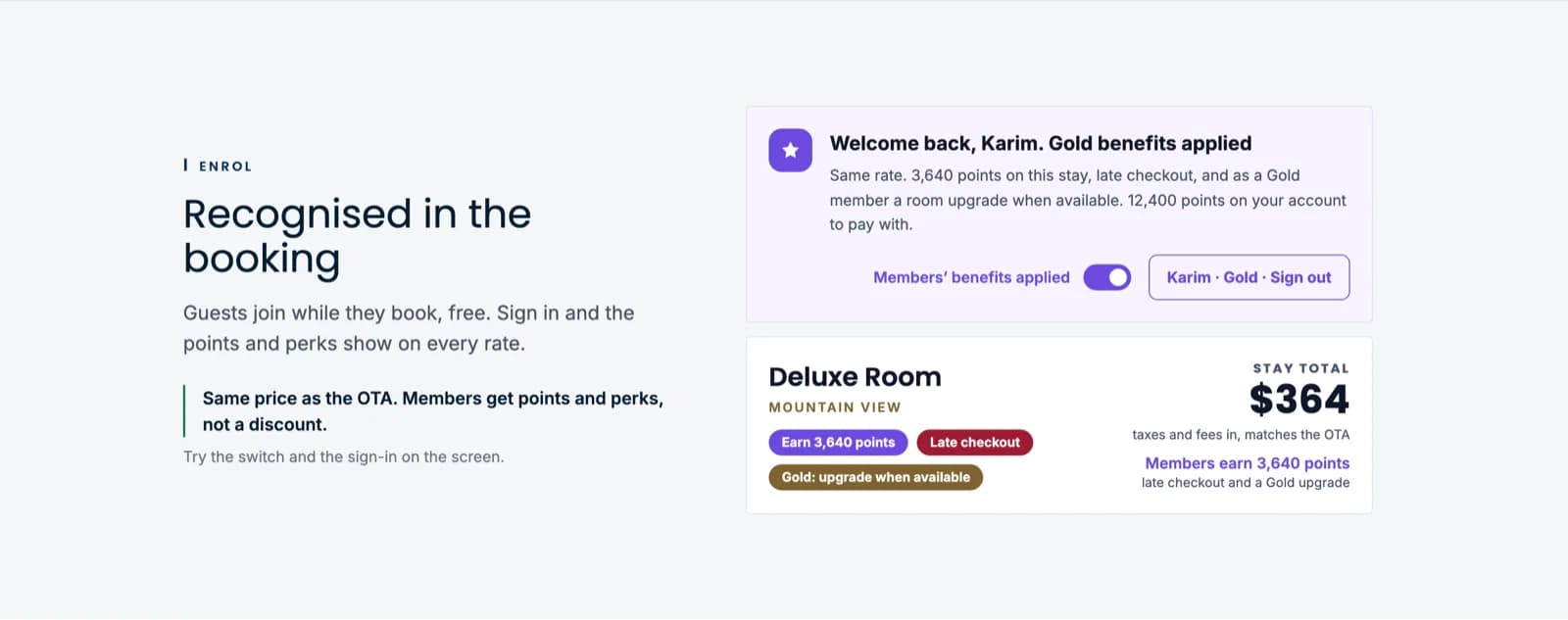
Hotel loyalty programmes are undergoing their most significant structural shift since points-based programmes arrived in the 1980s (Holiday Inn launched Priority Club in 1983, per IHG, 28 April 2008). The traditional earn-and-burn model, accumulate points, redeem for free nights, is losing relevance with a generation of travellers who value immediate recognition over deferred rewards. In parallel, AI-driven personalisation, subscription economics, and first-party data strategies are reshaping what loyalty means in hospitality.
This deep dive examines five trends redefining hotel loyalty in 2026, with practical implications for revenue managers and operators at both chain and independent properties. Not every trend will apply to every property, but ignoring all of them carries increasing competitive risk.
Trend 1: The Shift From Points to Instant Recognition
Why Points Are Losing Their Pull
For many younger travellers, points accumulation is no longer a strong enough reason to stay loyal to a hotel brand. The generational shift is not about attention spans, it is about perceived value. Younger travellers compare hotel loyalty to instant-gratification models in retail (same-day delivery), finance (cashback on every purchase), and food delivery (immediate discounts). Against that backdrop, a long count of nights before a free one feels outdated.
Instant value gives guests a reason to join and a reason to stay active. When you move from a points-only model to instant recognition, watch two numbers: enrolment, and the share of members with at least one stay in the past 12 months. The second tells you whether instant value is creating engagement, not just sign-ups.
What Instant Recognition Looks Like
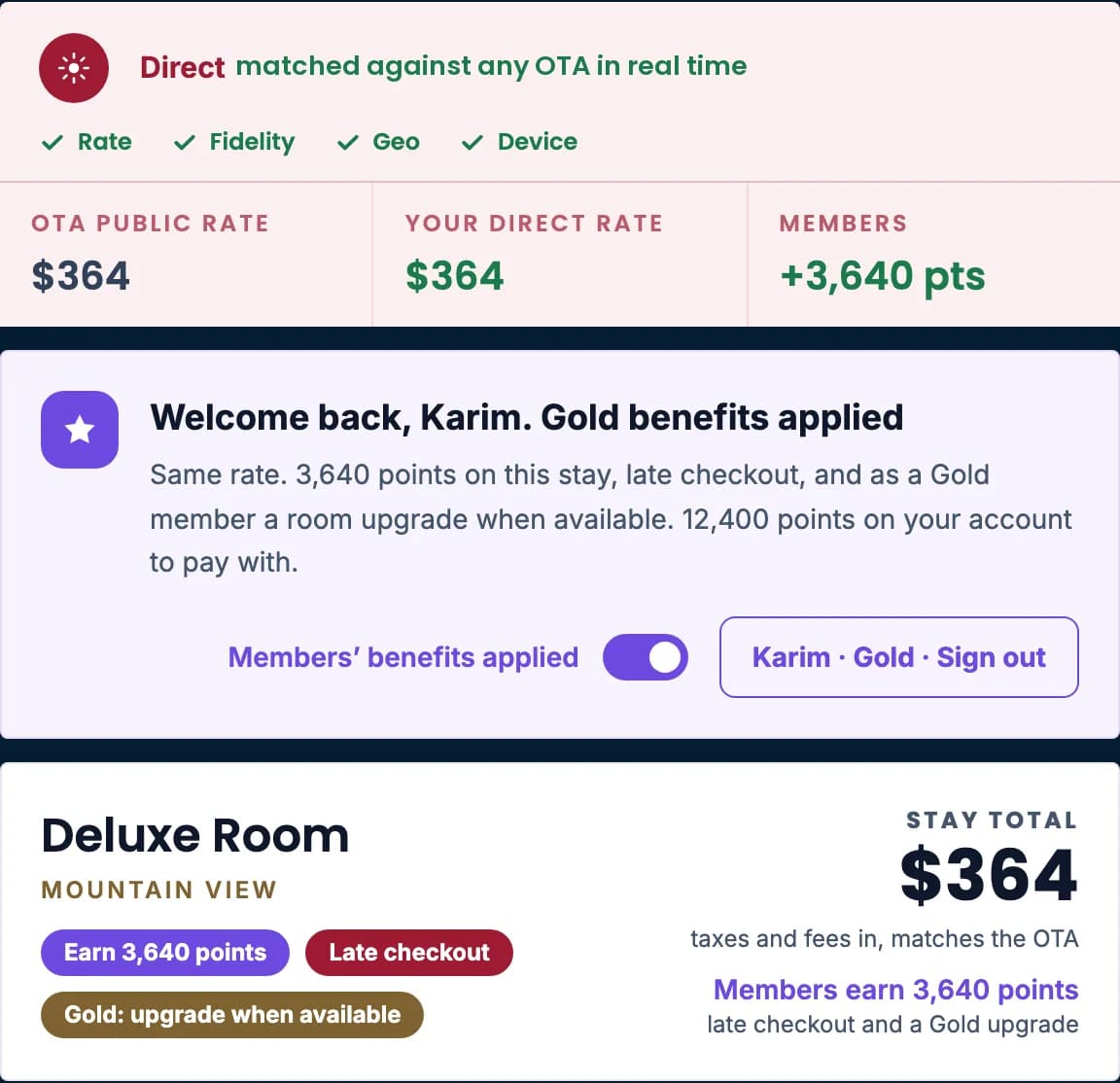
Instant recognition programmes deliver value on every stay, not after a threshold is reached. Practical implementations include:
- Member points and perks visible at the booking stage
- Guaranteed room upgrades based on availability at check-in
- Welcome amenity or F&B credit delivered automatically on arrival
- Personalised room setup based on stored preferences (pillow type, minibar, temperature)
- Express check-in/out with mobile key access
The important distinction is that these are not rewards for past behaviour, they are real-time benefits of being a member. This reframes loyalty from a delayed transaction ("earn now, redeem later") to an ongoing relationship ("being a member makes every stay better"). WhizzLoyalty is built for this kind of recognition; measure your repeat booking rate against your previous points-only model to see what it changes.
The Trade-Off: Cost Structure
Instant recognition is more expensive per stay than deferred rewards, because the benefit is delivered every time rather than occasionally. A points programme where only a minority of members redeem in a year has a very different cost profile from an instant programme where every member receives benefits on every stay. Careful cost modelling is essential. Set a ceiling for total programme cost as a share of member-generated room revenue, and check that the incremental repeat bookings more than offset the cost.
Trend 2: AI-Personalised Loyalty Experiences
Beyond Segment-Based Personalisation
Traditional loyalty personalisation operates at the segment level: business travellers get one set of offers, leisure travellers get another. AI-powered personalisation in 2026 operates at the individual level, using booking history, stay behaviour, digital engagement patterns, and contextual data to tailor the loyalty experience to each guest.
The practical applications are already in production at early-adopter properties:
- Dynamic reward selection: AI analyses a guest's past redemption behaviour and spending patterns to present the few rewards most likely to drive a rebooking, rather than showing the full reward catalogue
- Predictive churn detection: Machine learning models identify loyalty members at risk of lapsing before they go dormant, triggering proactive retention offers
- Personalised earning rates: Instead of a flat points-per-spend rate, AI adjusts earning rates based on the guest's sensitivity to different incentives: some guests respond to bonus points, others to experiential upgrades
- Contextual offer timing: Sending loyalty offers when the guest is most likely to be planning travel, based on their historical booking patterns and external signals
The AI personalisation landscape in hospitality is maturing rapidly. Test AI-driven loyalty personalisation against your rule-based approach and compare offer conversion and member satisfaction.
Data Requirements and Privacy
AI personalisation requires clean, consolidated guest data, which means your CRM must be the single source of truth for guest profiles. Fragmented data across PMS, booking engine, and loyalty platform makes AI personalisation impossible, regardless of how sophisticated the AI model is.
Privacy compliance is the second prerequisite. GDPR, the EU's AI Act, and evolving regional regulations set rules for data-driven personalisation. Properties that invest in consent management and transparent data practices now will have a structural advantage as regulations tighten. Those that delay will face both compliance risk and guest trust erosion.
Trend 3: Experiential Rewards Over Transactional Ones
The Shift in Reward Value Perception
Free nights and room upgrades remain the most familiar loyalty rewards, but experiential rewards, a private cooking class, a guided cultural tour, an exclusive dining event, give members something a discount cannot: a story to tell.
The implications for independent hotels are favourable. Unique local experiences are hard to offer consistently across hundreds of properties. An independent hotel embedded in its local community can curate experiential rewards of its own: partnerships with local chefs, artisans, tour operators, and cultural institutions create rewards that are both differentiated and often lower-cost than free nights.
Building an Experiential Reward Portfolio
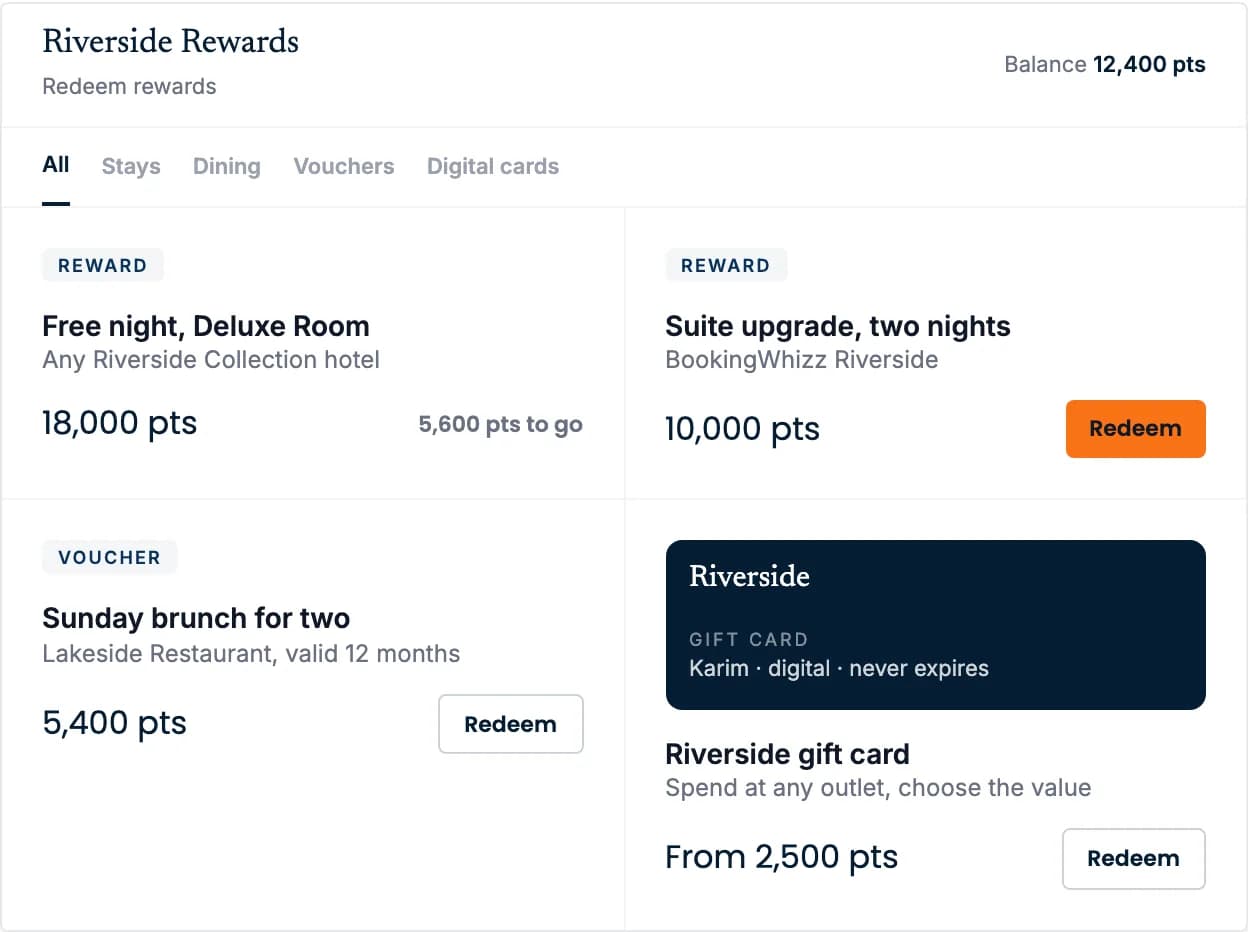
Start by auditing your local partnerships and the experiences available near your property. Categorise them by cost and perceived value:
- Low-cost, high-perceived-value: Behind-the-scenes kitchen tour with the chef, guided sunrise yoga on the rooftop, curated local walking itinerary
- Medium-cost: Partner-sourced cooking class, wine tasting at a local vineyard, private museum tour
- Premium: Private dining experience, half-day cultural immersion with a local expert, spa ritual with local ingredients
The key economic insight is that an experience can feel worth more to the guest than it costs the hotel, while a cash discount is worth exactly its face value. That gap is what makes experiential rewards effective at driving loyalty.
Operational Complexity: The Honest View
Experiential rewards require more operational coordination than transactional ones. You need partner agreements, scheduling logistics, quality control, and staff trained to deliver or facilitate the experience. Start with a few experiences and expand based on guest feedback and redemption data. Overcomplicating the portfolio at launch is a common mistake that leads to inconsistent delivery and disappointing guest experiences.
Trend 4: Subscription and Paid Loyalty Models
The Amazon Prime Effect Reaches Hospitality
Paid loyalty, where guests pay an annual or monthly fee for premium membership benefits, is an established model. Accor, for example, sells ALL Accor+ Explorer as a 12-month travel loyalty subscription membership (Accor). Travellers will pay for hotel membership when the value proposition is clear and the fee can be earned back quickly.
The behavioural logic is straightforward: a guest who has paid an annual membership fee is psychologically invested. They have committed financially, which creates a bias toward using the membership to "get their money's worth". Look for it in booking frequency, direct booking share, and price sensitivity, and compare paid members against free members on your own data.
Designing for the Independent Hotel
The membership model guide covers implementation details, but the 2026-specific trend is the emergence of tiered paid models: a free base tier for casual guests and a paid premium tier for committed travellers. This dual-track approach captures enrolment breadth from the free tier while generating committed members from the paid tier.
Pricing is the most sensitive decision. Set the fee too low and the perceived value of membership declines. Set it too high and enrolment suffers. Test fees against your own ADR, and make sure the fee is recoverable within a few stays based on the tangible benefits members receive on every stay.
Revenue Model Advantages
Beyond the behavioural benefits, paid loyalty changes the cash flow dynamics. Membership fees are collected upfront, creating predictable non-room revenue. To size it, multiply your expected paid members by the fee, then take off the cost of the per-stay benefits they receive. This cash flow predictability is particularly valuable for independent properties managing seasonal revenue volatility.
To see what these trends are worth to your own hotel, start with the room revenue your loyalty programme already brings in. Estimate the lift you expect from the trends you adopt, test it on a share of members, and compare with the rest before you choose where to invest.
Trend 5: First-Party Data as the Loyalty Foundation
The Privacy-First Loyalty Landscape
Tightening privacy regulations and the limits of third-party tracking have made first-party data, information collected directly from guest interactions with your property, the most valuable marketing asset a hotel owns. Google has kept third-party cookies in Chrome (Google Privacy Sandbox, April 2025), but data you collect yourself, with consent, does not depend on any browser's rules. Loyalty programmes are the primary mechanism for collecting this data at scale. Every enrolment, every booking, every stay generates first-party data that feeds personalisation, targeting, and retention.
In 2026, the hotels winning the loyalty game are those that explicitly design their programmes as first-party data collection engines. This does not mean being extractive with guest data, it means creating enough value in the loyalty exchange that guests willingly share preferences, booking intentions, and feedback. The guest engagement trends report explores this dynamic in broader detail.
Building a Data Flywheel
The most effective 2026 loyalty programmes create a data flywheel:
- Collection: Guest enrols, books, and stays, generating behavioural data
- Analysis: AI processes data to identify preferences, patterns, and propensities
- Personalisation: Next interaction is tailored based on analysis: the right offer, right channel, right time
- Enhanced value: Guest receives a better experience because of their data, reinforcing loyalty
- More data: Deeper engagement generates richer data, and the cycle accelerates
This flywheel requires integrated technology: your CRM, loyalty platform, and email and WhatsApp messaging must share data in both directions in real time. Properties operating these systems in silos cannot create the flywheel effect, regardless of how much data they collect.
Consent and Transparency as Competitive Advantage
The properties gaining the most first-party data in 2026 are those that are most transparent about how data is used. A clear value exchange, "share your preferences and we will personalise your stay", gives guests a reason to complete their profiles that opaque data collection buried in terms and conditions never will. Guest trust is not just a compliance requirement; it is a data strategy.
Implementing These Trends: A Prioritisation Framework
Where to Start Based on Your Current Position
Not every property should pursue all five trends simultaneously. Prioritise based on your current loyalty programme maturity:
No formal programme, or a new one: Start with Trend 1 (instant recognition), with points and perks members see as they book. This provides immediate guest value, drives direct bookings, and begins building your first-party data asset. Add Trend 5 (data flywheel) infrastructure from day one to avoid costly retrofitting later.
Established programme: Layer on Trend 3 (experiential rewards) to differentiate from competitors and improve member engagement. Begin testing Trend 2 (AI personalisation) with your highest-value member segments.
Mature programme: Evaluate Trend 4 (paid model) as an addition to your existing free tier. Implement Trend 2 broadly. Develop Trend 5 with advanced analytics and predictive modelling.
Measuring Progress
Track these KPIs to evaluate your loyalty evolution, and set each target from your own baseline:
- Active member rate (share of enrolled members with a stay in the past 12 months)
- Programme-attributed revenue share (of total room revenue)
- Member vs. non-member ADR differential (aim for members at or above non-member ADR)
- First-party data completeness (share of profiles with email, stay history, and at least one preference captured)
- Repeat booking rate for members
- Net programme ROI (incremental revenue minus programme costs)
See What This Means for Your Property
Get your WhizzAuditWhat This Means for 2026 and Beyond
The Convergence of Loyalty and Guest Experience
The overarching trend across all five developments is convergence: loyalty is becoming inseparable from the core guest experience rather than a bolt-on marketing programme. The best loyalty programmes in 2026 do not feel like programmes at all, they feel like the hotel knowing and caring about the guest as an individual.
This convergence favours independent hotels that can deliver genuine personal attention, where large chains must systematise recognition across thousands of locations. The technology gap between chains and independents is closing (tools like WhizzLoyalty provide enterprise-grade loyalty capabilities at independent-hotel scale), while the authenticity gap remains a structural advantage for properties where the GM knows repeat guests by name.
Loyalty does most when it is not on its own. Loyalty gives the guest a reason to book direct. The AI-powered CRM knows the guest and brings them back with the one right offer. PriceMatch AI removes the last reason to book elsewhere: it matches or beats the OTA price, plus your perks on top. Each helps alone; together they close the loop: win the first booking, keep the guest, win every booking after.
The Risk of Inaction
For properties still operating without a structured loyalty approach, the competitive risk is accelerating. As more hotels implement instant recognition, AI personalisation, and experiential rewards, the baseline guest expectation rises. A property that offers no loyalty value in 2026 faces increasing pressure on both acquisition (guests choosing competitors with better member benefits) and retention (no mechanism to bring guests back beyond rate discounting).
The loyalty landscape in 2026 rewards properties that treat guest retention as a strategic priority rather than an afterthought. The five trends outlined here, instant recognition, AI personalisation, experiential rewards, paid membership, and first-party data strategy, are not theoretical. They are already in use, and each one can be measured. The question for most properties is not whether to evolve their loyalty approach, but how quickly they can do so. A WhizzAudit can assess your current loyalty programme against these trends and identify the highest-impact improvements for your property.