Updated October 2026.
Short answer: the true cost of an OTA booking is the commission plus what follows it: rates undercut on the OTA, guest details you do not get, and a guest the OTA's own loyalty programme pulls back. Work it out for your own hotel with the formula below, then compare it with what a direct booking costs you.
| Cost to check | What to look at |
|---|---|
| Commission | The rate in your contract, plus any visibility programme on top of it. |
| Undercutting | Whether the OTA shows a lower price than your direct rate, by country, device and member level. |
| Guest data | Whether you can reach the guest again after checkout, with their consent. |
| Loyalty pull | Whether the guest's next booking comes to you or back to the OTA's programme. |
| Your direct alternative | What a booking costs you through your own site, metasearch and email. |
When you are ready to act on it, our guides cover how to choose a price match tool, how to choose a hotel CRM and how to choose a booking engine with loyalty built in.
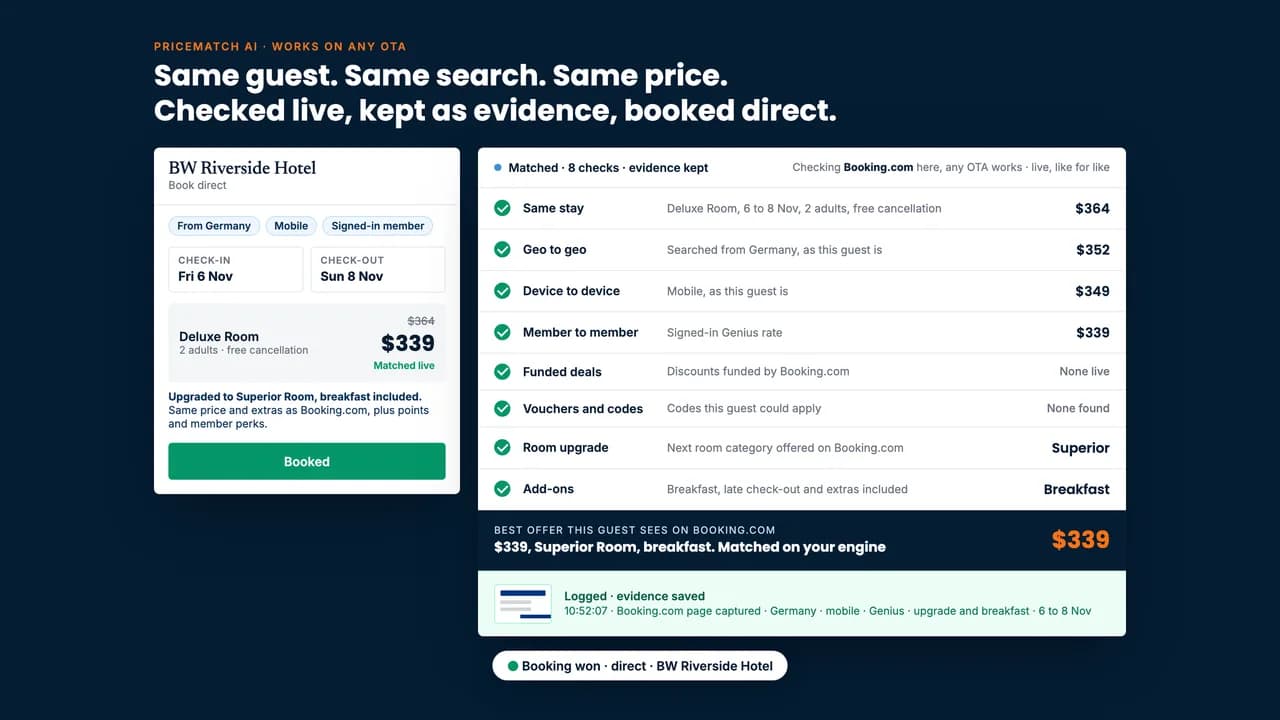
When revenue managers discuss OTA costs, the conversation almost always starts and ends with the commission percentage. OTA commission is a percentage of each booking, set in your contract and higher in visibility programmes. But commission is only the most visible line item in a much larger cost structure that most hotels never fully quantify. The true cost of OTA dependency, once you account for rate erosion, data loss, loyalty leakage, and brand dilution, is higher than the commission line on the invoice.
Understanding these hidden costs is not about demonising OTAs. They remain a necessary and valuable distribution channel. But making informed investment decisions about where to allocate your marketing and technology budget requires an honest accounting of what each channel actually costs.
The Visible Cost: Commission Rates in 2026
Let us start with the cost everyone knows. Commission varies by OTA, region, property type, and participation in preferred programmes, and it is agreed contract by contract.
Standard Commission Tiers
Booking.com's commission is set by contract and market; its Preferred Partner Programme adds visibility in exchange for a higher commission. Expedia Group operates several brands, including Hotels.com, Vrbo, and Orbitz. Regional OTAs such as Agoda and MakeMyTrip have their own commission terms and paid visibility options.
To size it for your own hotel, multiply your occupied room nights by the share that comes through OTAs, then by your average rate and your contracted commission. That is the commission line alone, before any of the costs below.
Preferred Programme Markups
OTAs increasingly push properties toward preferred or sponsored programmes that carry higher commission rates. The promised benefit is improved visibility, but the incremental bookings often come with lower margins than the standard tier. In April 2026, Italy's competition authority opened an investigation and said that selection for Booking.com's Preferred Partner Programme "appears to be driven largely by criteria that favour accommodation providers paying higher commissions to Booking.com". The investigation had not reached a finding when we checked.
Whether the extra bookings outweigh the extra commission is worth checking against your own data before and after enrolling. The volume gain does not always translate to profit.
The Hidden Costs Most Hotels Ignore
Commission is the cost you can see on your invoice. The following costs are harder to quantify but often exceed the commission itself.
Rate Erosion and Undercutting
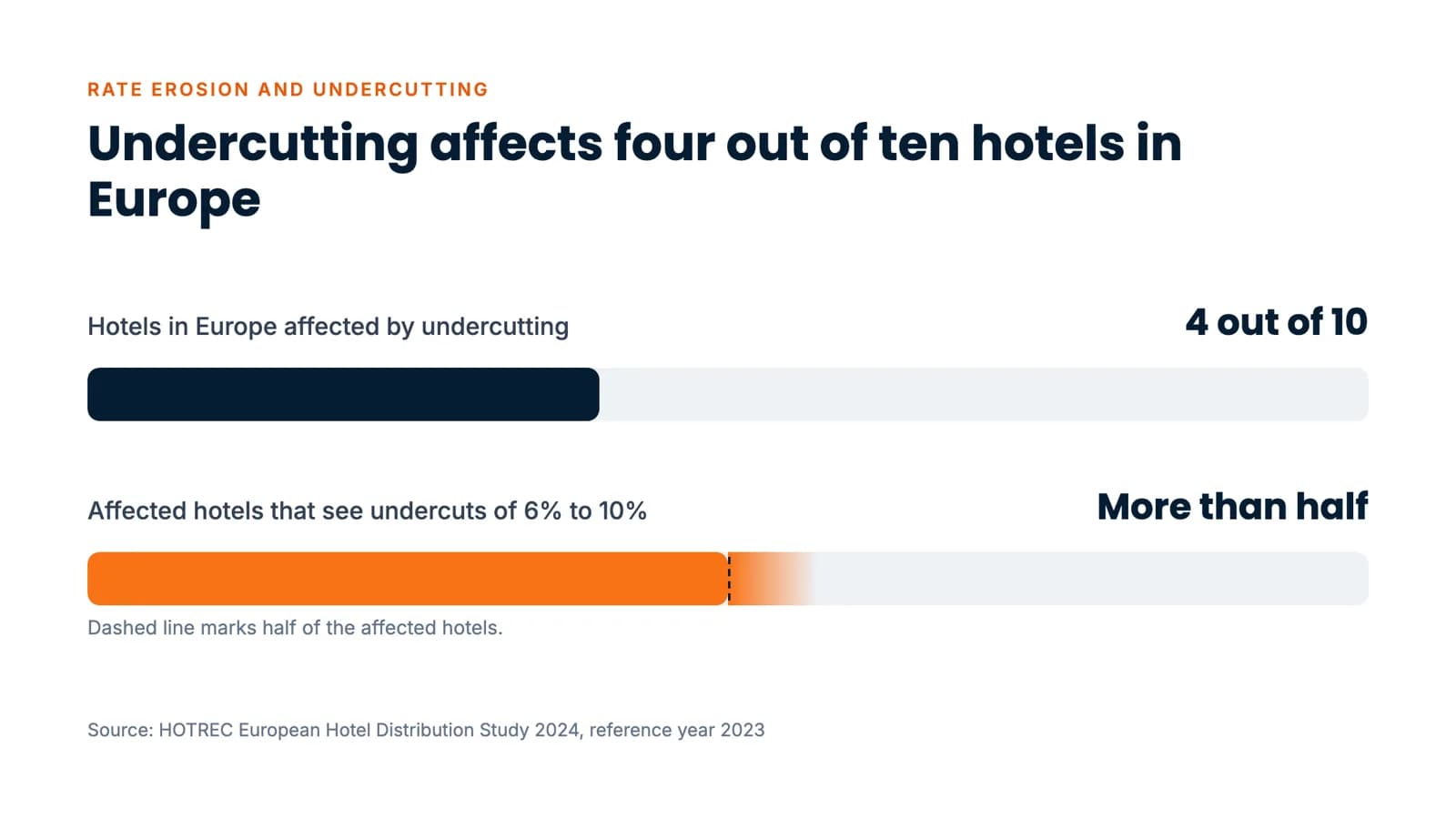
OTAs can undercut the rates hotels set through a variety of mechanisms: mobile-only discounts, loyalty member pricing, Genius or VIP rates, and wholesale rate leakage. The HOTREC European Hotel Distribution Study 2024 defines undercutting as "a practice where an OTA cuts the price set by a hotel by waiving part of its own commission", and found that it affects four out of ten hotels in Europe. More than half of the affected hotels see undercuts ranging from 6% to 10%. That eats directly into the hotel's ability to compete for direct bookings, which is why a rate parity analysis belongs in any channel review.
This rate leakage is not accidental. It is structurally embedded in how OTAs operate their loyalty programmes. Discounted OTA prices train consumers to expect lower OTA prices, making your direct channel less competitive even when your rates are at parity.
Guest Data and Relationship Loss
Every OTA booking is a guest relationship you do not own. The OTA controls the guest's email, phone number, and booking preferences. You receive a masked email address and limited contact information that expires shortly after checkout.
The revenue impact of this data loss compounds over time. Hotels with strong direct booking strategies can invite guests whose details they hold back for another stay; guests booked through an OTA usually cannot be reached in the same way.
Brand Dilution and Commoditisation
On an OTA, your property competes on price, location, and review score. Your brand story, design aesthetic, and unique value proposition are reduced to a standard template with limited differentiation. Over time, this commoditisation erodes your ability to command a premium and trains guests to view your property as interchangeable with competitors.
For luxury and lifestyle properties, this brand dilution carries a real cost. A strong brand story is easier to tell, and to price, on your own website.
Loyalty Programme Conflict
OTA loyalty programmes directly compete with your own retention efforts. Booking.com Genius, Expedia Rewards, and Hotels.com reward programmes give guests a reason to return to the OTA rather than to you.
These costs are specific to each hotel. Use the WhizzAudit to put your own numbers into this.
Calculating Your True Cost Per OTA Booking
To make informed channel investment decisions, you need a complete cost-per-acquisition figure for each channel. Here is a practical framework.
The Full Cost Formula
True OTA Cost = Commission + Rate Erosion Impact + (Guest LTV Loss x Probability of Repeat) + Brand Dilution Premium Loss. Work it out for your own hotel, and run the same sum for each direct channel, including paid acquisition costs.
This does not mean every OTA booking is unprofitable. New customer acquisition through OTAs can be worthwhile if you have a strong conversion funnel to shift guests to direct bookings on their second stay. The key metric to track is your OTA-to-direct conversion rate: track it monthly and set a target from your own baseline.
Where OTAs Still Deliver Value
Despite these costs, OTAs provide genuine value in specific scenarios: new market exposure where you have no brand recognition, last-minute inventory fill during low-demand periods, and international traveller acquisition where language and payment barriers make direct booking friction high. Cornell research on the billboard effect found that listing on Expedia raised a hotel's non-OTA reservations by "7.5 to 26 percent for the four properties in this study" (Anderson, 2009). The goal is not to eliminate OTAs but to optimise your channel mix so that OTA spend is strategic rather than structural.
Reducing True OTA Costs: Practical Steps
Rate Parity Monitoring and Enforcement
A direct place to start is making sure your direct rate is never undercut. PriceMatch AI checks the OTA price live, while the guest is on your own booking page, and matches or beats it like for like, plus your points and perks on top.
Billboard Effect Optimisation
The billboard effect, where OTA listings drive guests to book directly, is real. To make the most of it, ensure your website offers a clear reason to book direct: a price that matches or beats the OTA, plus points and perks, and flexible cancellation.
Metasearch as an Alternative Acquisition Channel
Metasearch platforms like Google Hotel Ads, Trivago, and TripAdvisor offer a direct acquisition channel where you control the rate, and the booking and the guest's details come to you. See our guide to well-managed metasearch campaigns for how to measure what it costs you per booking.
Guest Conversion Programmes
For guests who do arrive via OTA, invest in on-property conversion. Collect email addresses at check-in, offer direct booking incentives for future stays, and ensure your post-stay communication drives rebooking through your own channels.
This is where loyalty, CRM and PriceMatch AI work best together. Loyalty gives the guest a reason to book direct. The AI-powered CRM knows the guest and brings them back with the one right offer. PriceMatch AI removes the last reason to book elsewhere: it matches or beats the OTA price, plus your perks on top.
See What This Means for Your Property
Get your WhizzAuditThe Strategic Mindset Shift
The most effective revenue managers have stopped thinking about OTA commission as a fixed cost of doing business. Instead, they treat it as a variable marketing expense that should be benchmarked against alternative acquisition channels on a true cost basis.
When you compare the full cost of an OTA booking with what metasearch or email costs you per booking, the case for direct channels is clear. This does not mean slashing OTA inventory tomorrow. It means gradually shifting budget toward channels that deliver higher net revenue while using OTAs strategically for market reach.
Properties that have taken this approach, like Ewaa Hospitality, a hotel group in the UAE, have seen results: they grew direct bookings 156% over six months (see the Ewaa case study). The first step is simply measuring what your OTAs truly cost. Once you have that number, the strategy writes itself.